Stanford Fisher Family Summer Fellows Program 2027
Disclaimer
jehlum.in publishes this article purely for informational purposes. We hold no affiliation with Stanford University, the Center on Democracy, Development and the Rule of Law (CDDRL), or the Freeman Spogli Institute for International Studies.
We do not process applications, and we charge no fee for this information.
Deadlines, eligibility criteria and submission rules change without notice, so verify every detail on the official Stanford CDDRL website (cddrl.fsi.stanford.edu) before applying.
jehlum.in accepts no liability for any loss, delay or inconvenience arising from reliance on this article.
Stanford Fisher Family Summer Fellows Program 2027
Last updated: October 2026. Official source: Stanford CDDRL (cddrl.fsi.stanford.edu/summerfellows).
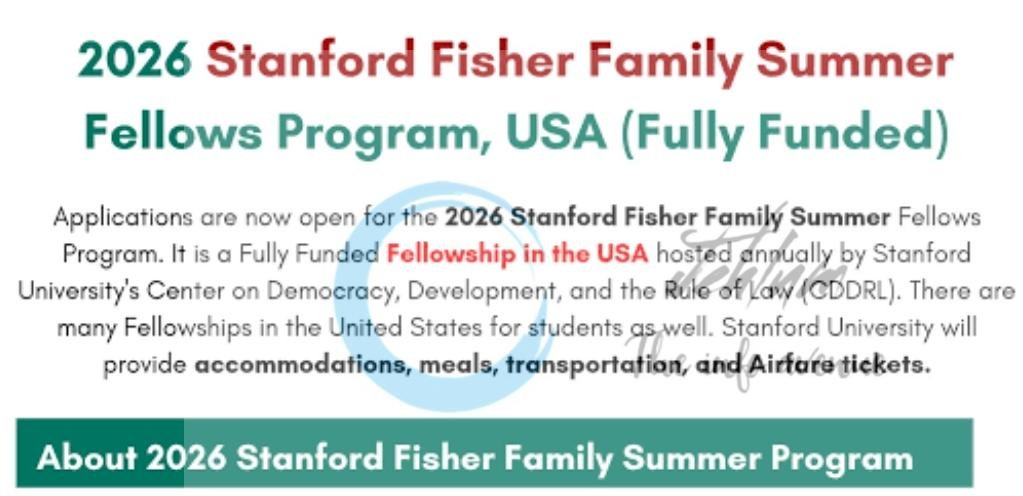
The Center on Democracy, Development and the Rule of Law (CDDRL) at Stanford University has opened applications for the 2027 Fisher Family Summer Fellows Program.
Formerly known as the Draper Hills Summer Fellows Program, this prestigious fellowship brings together mid-career practitioners from transitioning countries.
Specifically, the program focuses on advancing democratic practices and enacting economic and legal reform.
Over three intensive weeks, fellows exchange experiences, receive academic and policy training, and build a global network.
Below, this guide explains the eligibility rules, the realistic cost structure, and the step-by-step application process for Indian applicants.
Table of Contents
- Programme at a Glance
- What is the Fisher Family Summer Fellows Program?
- Benefits and the Realistic Cost Structure
- Eligibility Criteria
- Specific Notes for Indian Applicants
- Required Application Materials
- How to Apply Step by Step
- Important Dates
- FAQs for Indian Applicants
Programme at a Glance
Stanford Fisher Family Summer Fellows Program 2027
First, let us examine the fundamental facts of the fellowship.
This summary table highlights the core details and critical deadlines for the 2027 cohort.
| Feature | Details |
|---|---|
| Program Name | Fisher Family Summer Fellows Program on Democracy and Development |
| Host Institution | Stanford University (CDDRL / FSI) |
| Location | Stanford Campus, California, USA |
| Duration | 3 Weeks (July 18 – August 6, 2027) |
| Funding Type | Partially Funded (Accommodation, meals, local transport covered) |
| Application Deadline | January 12, 2027 (11:59 pm PST) |
| Official Portal | Slideroom Application Portal |
What is the Fisher Family Summer Fellows Program?
Stanford Fisher Family Summer Fellows Program 2027
Launched in 2005, this program serves as a professional training forum for civil society leaders.
Instead of a traditional academic summer school, it functions as a competitive fellowship for practitioners already working in the field.
Approximately 30 mid-career professionals are selected annually from hundreds of applicants worldwide.
The curriculum combines academic sessions with case study workshops, guest lectures, and “TED”-style talks by the fellows.
Consequently, participants learn from leading Stanford faculty, including Michael McFaul, Francis Fukuyama, and Larry Diamond.
Furthermore, fellows join an alumni network of over 500 leaders from 96 countries.
Benefits and the Realistic Cost Structure
Stanford Fisher Family Summer Fellows Program 2027
Many third-party websites mistakenly label this program as “fully funded.” Therefore, applicants must understand the actual financial structure.
What Stanford Covers
Stanford provides accommodation for the entire three-week duration on campus.
Additionally, the program covers meals and local transportation for all program activities.
What the Fellow Covers
Typically, fellows are expected to cover their own round-trip airfare to California.
However, a small travel fund exists for fellows who cannot afford the flight or need a partial subsidy.
Priority for this travel fund goes to candidates from destinations with exorbitant airline fares.
Notably, the program does not provide funding for families or dependents to accompany fellows.
Eligibility Criteria
Stanford Fisher Family Summer Fellows Program 2027
To begin with, applicants must carefully review the strict conditions set by CDDRL.
Professional Experience
Specifically, this is not an academic fellowship, meaning current full-time university students are not eligible.
Candidates must be mid-career practitioners with at least 10 to 12 years of professional experience.
They should hold a leadership role in government, civil society, public policy, or economic development.
Age and English Requirements
Furthermore, candidates must be at least 28 years of age by July 2027 (the average fellow is 38).
They must also demonstrate a strong command of written and spoken English.
All sessions, materials, and a mandatory 7-minute “TED”-style talk are delivered in English.
Country of Residence
Most importantly, candidates must be from and currently reside in a country where democracy is not well entrenched.
Applicants from highly democratic nations such as the U.S., Canada, Australia, Japan, and EU member states are not accepted.
Specific Notes for Indian Applicants
Stanford Fisher Family Summer Fellows Program 2027
India is a developing democracy and is not explicitly excluded from this program.
However, the selection committee heavily focuses on regions like Eurasia and Africa, which constitute nearly half the alumni network.
Indian applicants working in civil society, legal reform, or public policy may apply.
Nevertheless, they must clearly demonstrate how their work addresses fragile democratic institutions or governance challenges.
Because the program is highly competitive, Indian candidates should highlight significant contributions to social or political reform.
Required Application Materials
Consequently, students must gather specific materials before initiating the online process.
Core Documents
A resume or CV is mandatory, with a strict maximum length of three pages.
Applicants must also provide the contact details of two references to submit letters of recommendation.
Essays and Video
The application requires multiple short essays, mostly around 150 words each.
These essays cover the applicant’s impact, personal motivation, and a proposed title for their “TED”-style talk.
Crucially, applicants must record and upload a 2-minute video submission (MP4 or MOV format).
This video serves as an “elevator pitch” explaining why the candidate should be selected.
How to Apply Step by Step
Online Portal Registration
To begin the application, create an account on the official Slideroom portal.
Next, complete the personal, academic, and career information sections.
Once those sections are done, upload your three-page CV in PDF or MS Word format.
After that, draft and paste your responses to the essay questions into the form.
Then, record your 2-minute video and upload it to the portfolio section.
Finally, enter the contact details for your two recommenders.
Monitor your email closely, as Slideroom will notify your references to submit their letters.
Final Submission
Crucially, review all your work before clicking submit, as you cannot make changes afterward.
Therefore, ensure all recommendation letters are submitted before the January deadline.
Important Dates
Stanford Fisher Family Summer Fellows Program 2027

The university enforces a strict single deadline for this fellowship.
| Action Required | Date / Timeline |
|---|---|
| Application Deadline | January 12, 2027 (11:59 pm PST) |
| Letters of Recommendation Due | January 12, 2027 |
| Selection Notification | April 2027 |
| Program Dates | July 18 – August 6, 2027 |
FAQs for Indian Applicants
Eligibility and Program Rules
1. I am an Indian citizen. Am I eligible for this fellowship?
Yes, you are eligible to apply. The program excludes citizens of the U.S., Canada, Australia, Japan, and EU member states, but not India.
However, you must demonstrate that you work in a field related to democracy, development, or the rule of law, and meet the experience requirements.
2. Is this a fully funded scholarship?
No, it is not fully funded. Stanford covers accommodation, meals, and local transport during the three weeks.
Typically, fellows cover their own round-trip airfare, though a small travel fund exists for those with financial need.
3. Can I apply if I am currently enrolled in a PhD or Master’s program in India?
No, the program explicitly states that current full-time university students are not eligible.
This fellowship is strictly for mid-career practitioners who are actively working in their respective fields.
Application and Visa Logistics
4. Do I need to submit a TOEFL or IELTS score?
No, the program does not require standardized English test scores.
However, you must have a solid command of spoken and written English, as you will need to participate in discussions and deliver a 7-minute talk.
5. What visa will I need to attend the program in the USA?
Since this is a short professional fellowship, you will likely need a B-1 visitor visa for business.
Stanford will provide an official invitation letter after selection, which you will present during your visa interview.
6. Can I bring my spouse or children to Stanford?
The program does not provide funding or housing for families.
Furthermore, Stanford policy prohibits housing children under 18 on campus, so you would need to self-fund off-campus housing. The program does not recommend bringing family members.
7. How long should my CV be?
Your CV must not exceed three pages.
The program team will not review CVs longer than three pages, and they must be uploaded in PDF or MS Word format.
Selection and Documentation
8. What is the video submission about?
You must record a 2-minute video explaining why you should be selected.
It serves as an “elevator pitch” and must be in MP4 or MOV format, no larger than 250 MB.
9. Can I edit my application after submitting it?
No, once you submit the application, you cannot make any changes.
Therefore, review all your essays, CV, and video carefully before clicking the final submit button.
10. How competitive is the fellowship for Indian applicants?
The program is highly competitive, selecting only about 30 fellows from hundreds of applicants globally.
Indian applicants should highlight a strong record of leadership and tangible impact in democracy, development, or legal reform.